Laser distance sensors are widely used in industrial automation, robotics, smart transportation, UAV systems, warehouse logistics, and intelligent agriculture. Compared with traditional ultrasonic or infrared sensors, laser distance sensors provide higher accuracy, faster response, and longer measuring ranges.
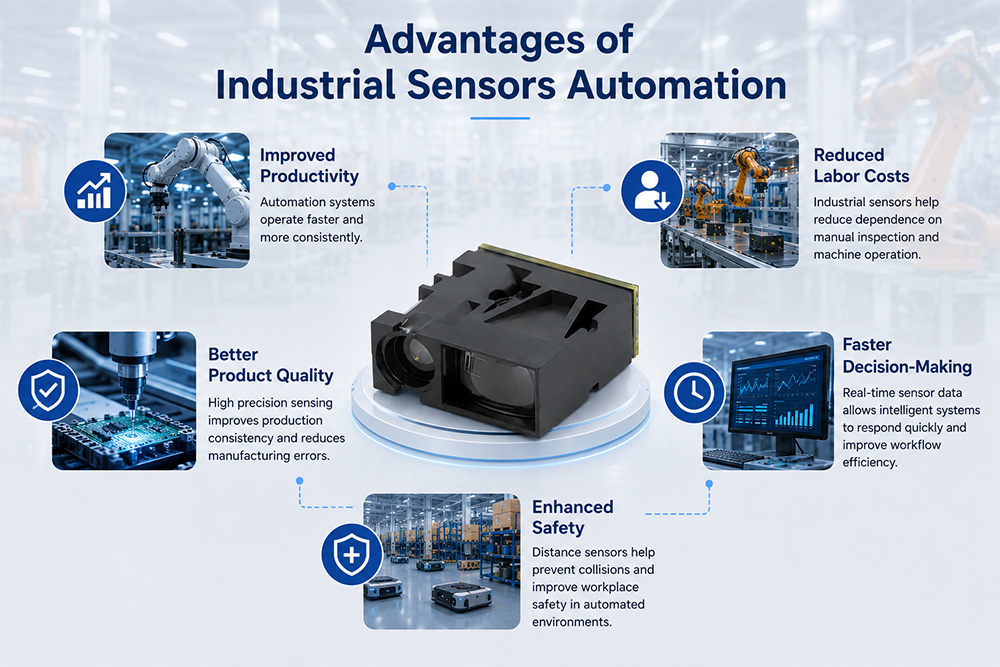
In this article, we will explain the working principle of laser distance sensors, common measurement technologies, and how they are applied in modern industries.
What Is a Laser Distance Sensor?
A laser distance sensor is an electronic device that measures the distance between the sensor and a target object by emitting a laser beam and analyzing the reflected signal.
The sensor mainly consists of:
-
Laser emitter
-
Optical lens
-
Receiving photodiode
-
Signal processing circuit
-
Microcontroller unit (MCU)
The laser beam is projected toward the target surface, and the reflected light returns to the receiver. The sensor then calculates the distance based on the characteristics of the returned signal.
How Does a Laser Distance Sensor Work?
The basic operating process of a laser distance sensor includes four steps:
-
The sensor emits a laser beam toward the target.
-
The laser light reflects off the target surface.
-
The reflected signal returns to the receiver.
-
The internal processor calculates the distance.
The measurement result is then output through interfaces such as UART, RS232, RS485, USB, or analog output.
Main Laser Distance Measurement Principles
There are several laser ranging technologies used in modern sensors. The most common methods include:
-
Time of Flight (TOF)
-
Phase Shift Measurement
-
Triangulation Measurement
Each technology has different advantages depending on the application scenario.
1. Time of Flight (TOF) Principle
Time of Flight is one of the most widely used laser measurement technologies for medium and long-distance applications.
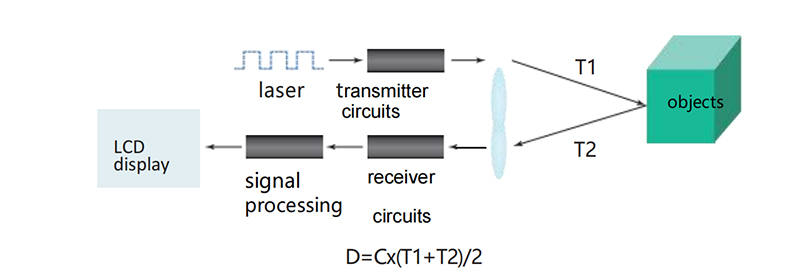
The sensor measures the time required for the laser pulse to travel to the target and return.
The distance calculation principle is:
d=c×t2d=\frac{c\times t}{2}d=2c×t
Where:
-
ddd = distance
-
ccc = speed of light
-
ttt = round-trip travel time of the laser pulse
Because light travels extremely fast, the sensor must use highly precise timing circuits.
Advantages of TOF Sensors
-
Long measuring range
-
Fast response speed
-
Good outdoor performance
-
Suitable for drones, lidar, and industrial automation
Typical Applications
-
UAV altitude measurement
-
Autonomous vehicles
-
Smart transportation
-
Security monitoring
-
Long-range laser rangefinders
2. Phase Shift Measurement Principle
Phase shift laser sensors are commonly used for high-precision short and medium-range measurement.
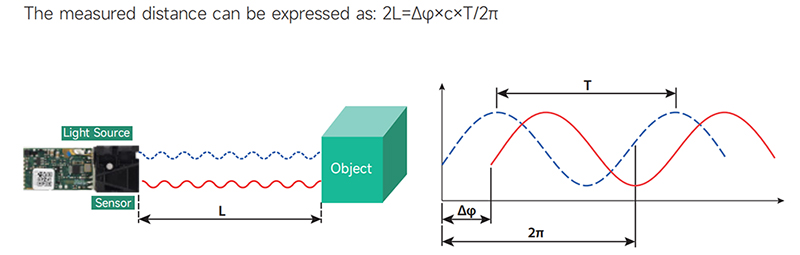
Instead of measuring travel time directly, the sensor emits a continuously modulated laser signal and calculates the phase difference between emitted and reflected light.
The distance is determined by:
d=Δϕ×λ4πd=\frac{\Delta\phi\times \lambda}{4\pi}d=4πΔϕ×λ
Where:
-
Δϕ\Delta\phiΔϕ = phase difference
-
λ\lambdaλ = modulation wavelength
Advantages of Phase Shift Sensors
-
Millimeter-level accuracy
-
Stable measurement
-
Compact sensor size
-
High repeatability
Typical Applications
-
Industrial automation
-
Smart warehousing
-
Precision positioning
-
Robotics
-
AGV navigation
Phase-shift technology is especially suitable for applications requiring high accuracy and compact integration.
3. Laser Triangulation Principle
Laser triangulation sensors measure distance based on the geometric position of the reflected laser spot.
When the target moves, the reflected light spot shifts on the image sensor. The system calculates distance through geometric relationships.
The triangulation relationship can be simplified as:
d=f×Bxd=\frac{f\times B}{x}d=xf×B
Where:
-
ddd = distance
-
fff = lens focal length
-
BBB = baseline distance
-
xxx = image displacement
Advantages of Triangulation Sensors
-
Extremely high accuracy
-
Excellent short-range performance
-
Fast sampling speed
Typical Applications
-
Thickness measurement
-
Surface inspection
-
Electronic manufacturing
-
Precision industrial control
Key Components Inside a Laser Distance Sensor
Modern laser ranging modules integrate several important components:
Laser Diode
Generates the laser beam used for measurement.
Receiving Lens
Collects reflected light from the target.
Photodetector
Converts optical signals into electrical signals.
Signal Processing Unit
Calculates distance data using advanced algorithms.
Communication Interface
Outputs measurement data to external devices.
Common interfaces include:
-
UART
-
RS232
-
RS485
-
USB
-
Bluetooth
-
Analog output
Factors Affecting Laser Distance Sensor Accuracy
Several environmental and technical factors influence measurement performance.
Target Surface Reflectivity
Dark or transparent objects may reduce signal quality.
Ambient Light
Strong sunlight can interfere with optical reception.
Measurement Angle
Large target angles may weaken reflected signals.
Temperature
Extreme temperatures can slightly affect internal circuits.
Measurement Range
Longer distances usually introduce larger errors.
Advantages of Laser Distance Sensors
Compared with traditional measurement technologies, laser distance sensors offer:
-
Non-contact measurement
-
High precision
-
Fast response
-
Long service life
-
Compact size
-
Strong anti-interference capability
These advantages make laser sensors ideal for intelligent automation systems.
Applications of Laser Distance Sensors
Laser distance sensors are widely used across many industries.
Industrial Automation
Position monitoring, equipment control, and automated production lines.
Robotics
Obstacle avoidance, navigation, and positioning.
Smart Agriculture
Crop monitoring and agricultural machinery automation.
Warehouse Logistics
Forklift positioning and AGV navigation.
UAV and Drones
Altitude control and terrain following.
Smart Transportation
Vehicle detection and traffic monitoring.
Future Trends of Laser Distance Sensing Technology
As industrial automation and intelligent systems continue to grow, laser distance sensors are becoming:
-
Smaller
-
More accurate
-
Faster
-
Lower power consumption
-
Easier to integrate
Emerging technologies such as 3D lidar, AI vision systems, and autonomous robotics are driving further innovation in laser sensing solutions.
Conclusion
Laser distance sensors play an essential role in modern automation and intelligent systems. By using technologies such as Time of Flight, phase shift measurement, and triangulation, these sensors provide accurate and reliable distance data across a wide range of applications.
Choosing the right laser measurement principle depends on the required accuracy, measuring range, speed, and environmental conditions. As laser technology continues to evolve, laser distance sensors will become even more important in industrial, commercial, and smart-device applications.